


Most businesses don’t have a lead problem. They have a lead quality problem.
This guide shows how to generate qualified leads using systems instead of guesswork.
What Are Qualified Leads (And Why Most Businesses Get This Wrong)
Understanding the difference between a lead and a qualified lead is fundamental to building a profitable business.
A lead is simply someone who shows interest in your business.
A qualified lead is someone who fits your ideal customer profile, has the budget to buy, and demonstrates genuine intent to purchase.
Lead vs Qualified Lead: Quick Comparison
| Regular Lead | Qualified Lead |
|---|---|
| Shows general interest | Has specific need and budget |
| May be browsing or researching | Ready to evaluate solutions |
| Conversion rate: 1-3% | Conversion rate: 15-30% |
| Timeline unclear | Decision timeline defined |
| May lack authority to buy | Decision-maker or influencer |
This distinction matters because traffic doesn’t equal revenue. You can drive thousands of visitors to your website, but if they’re not qualified, they won’t convert. Research shows that properly qualified leads convert at rates 5-10 times higher than unqualified leads.
Consider this example:
- Company A generates 100 leads per month with a 2% conversion rate, resulting in 2 customers.
- Company B generates only 10 qualified leads per month but converts at 20%, also resulting in 2 customers.
The difference? Company B spends far less time and resources chasing dead ends.
The key is understanding that qualified leads possess three critical attributes:
- They have a genuine need for your solution
- They have a budget to afford it
- They have authority to make purchasing decisions
Without these elements, you’re simply collecting contact information, not building a sales pipeline.
Why Most Lead Generation Fails?
Lead generation fails when businesses prioritize volume over value. The most common mistakes include running campaigns without proper targeting, failing to filter leads before they enter the sales pipeline, and lacking systematic follow-up processes.
Here’s what typically goes wrong:
- No targeting: Running ads to broad audiences without defining who your ideal customer is
- No filtering: Letting anyone submit a form or book a call, regardless of fit
- No follow-up system: Leads slip through the cracks because there’s no automated nurture sequence
- Optimizing for volume instead of intent: Celebrating high lead numbers while conversion rates remain low
This manifests in several ways:
- Ads without qualification questions or budget filters
- Content that attracts browsers instead of buyers
- Funnels built without conversion logic or lead scoring
Choosing the right partner matters. A strong digital marketing agency in India focuses on systems, conversions, and revenue—not just traffic and impressions.
The 3 Systems That Generate Qualified Leads
Generating qualified leads consistently requires three interconnected systems working in harmony. This is the same framework we use at Egara Digital to help businesses build predictable lead pipelines. Each system serves a specific purpose in attracting, filtering, and converting the right prospects.
Traffic System – Attract the Right Audience
Your traffic system determines who discovers your business. The goal isn’t maximum traffic but rather targeted traffic from people who match your ideal customer profile.
Start with SEO intent targeting:
Focus on keywords that indicate buying intent rather than just information gathering. For example, someone searching ‘best CRM for small business’ has higher intent than someone searching ‘what is CRM’.
A strong SEO service isn’t about rankings alone. It’s about attracting high-intent traffic that is already searching for what you offer.
Create content that speaks directly to buyer pain points:
Don’t just educate, demonstrate understanding of the specific challenges your ideal customers face. Address their industry-specific problems, their budget constraints, and their timeline pressures.
Platform selection matters:
LinkedIn works well for B2B marketing, Google captures high-intent searches, and Instagram can work for visual products and services. Choose platforms where your ideal customers actually spend time and are in a buying mindset.
Key principle: Right traffic beats more traffic. A hundred visitors who match your ideal customer profile are worth more than a thousand random visitors.
Qualification System – Filter Before You Sell
Your qualification system prevents unqualified leads from consuming your sales team’s time. This system filters prospects before they ever reach a human.
Implement smart forms that ask qualifying questions:
Don’t just collect name and email. Ask about budget range, timeline, company size, or specific challenges. These data points help you prioritize which leads deserve immediate attention.
Consider AI chat filters that can qualify leads 24/7:
Modern chatbots can ask budget questions, understand intent, and route qualified leads to your sales team while providing helpful resources to those who aren’t ready to buy.
Set booking rules that prevent calendar chaos:
If your service starts at $5,000, don’t let someone with a $500 budget book a call. Build qualification criteria into your scheduling system.
For example, instead of a generic ‘Contact Us’ form, use qualification fields like:
- Budget range: <$5K, $5K-$15K, $15K-$50K, $50K+
- Timeline: Immediate (0-30 days), Soon (1-3 months), Planning (3-6 months)
- Service type: SEO, Social Media Management, Full Digital Marketing
For example, our work in digital marketing for interior designers focuses on attracting clients who already understand project value and budgets, not just browsing for inspiration.
Conversion System – Turn Leads into Clients
The conversion system is where qualification meets action. This is about speed, consistency, and trust-building.
Response time is critical:
Studies show that contacting a lead within 5 minutes versus 30 minutes can increase conversion rates by 21 times. Implement automated responses that acknowledge receipt and set expectations, even if a human can’t respond immediately.
Build follow-up automation:
Build a follow-up automation that nurtures leads through email and messaging. Not every qualified lead is ready to buy today. A systematic follow-up sequence keeps you top-of-mind without manual effort.
Make calendar booking frictionless:
Qualified leads should be able to book discovery calls instantly, not wait for email back-and-forth. Use scheduling tools that sync with your availability and send automatic reminders.
Deploy trust signals strategically:
Case studies, testimonials, and social proof should appear at decision points in your funnel. Show prospects that businesses like theirs have succeeded with your solution.
Remember this: Most revenue is lost after the lead arrives. A perfect traffic and qualification system means nothing if your conversion process is slow, inconsistent, or lacks credibility.
How to Build a Lead Qualification Funnel?
A lead qualification funnel moves prospects from initial contact to customer through defined stages. Each stage serves a specific purpose and includes built-in qualification criteria.
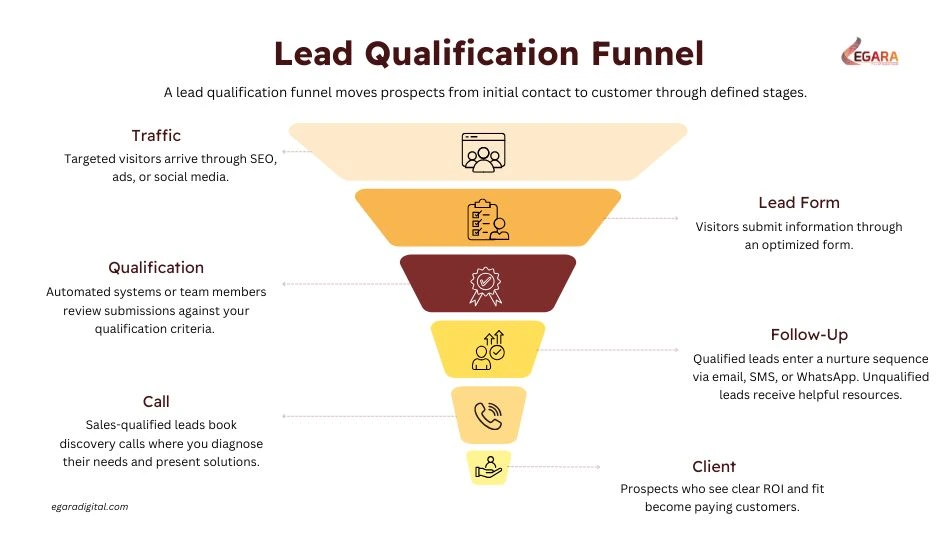
Here’s the flow:
Traffic → Lead Form → Qualification → Follow-Up → Call → Client
- Traffic: Targeted visitors arrive through SEO, ads, or social media. They’re searching for solutions to specific problems.
- Lead Form: Visitors submit information through an optimized form that balances collecting necessary data with maintaining high conversion rates. Keep it short for top-of-funnel offers, more detailed for bottom-of-funnel conversions.
- Qualification: Automated systems or team members review submissions against your qualification criteria. This is where you separate MQLs (marketing qualified leads) from SQLs (sales qualified leads).
- Follow-Up: Qualified leads enter a nurture sequence via email, SMS, or WhatsApp. Unqualified leads receive helpful resources and are tracked for future opportunities.
- Call: Sales-qualified leads book discovery calls where you diagnose their needs and present solutions. The goal is understanding, not pitching.
- Client: Prospects who see clear ROI and fit become paying customers. The sales process should feel natural, not forced.
What is a Marketing Qualified Lead & Sales Qualified Lead?
Marketing Qualified Lead (MQL)
A Marketing Qualified Lead is a prospect who has shown interest in your product or service through marketing efforts and meets certain criteria that indicate they’re more likely to become a customer than other leads.
Characteristics:
- Downloaded a lead magnet (eBook, checklist, template)
- Attended a webinar or workshop
- Engaged with multiple pieces of content
- Visited pricing pages or high-intent pages multiple times
- Opened and clicked through marketing emails
- Fits your ideal customer profile (ICP) based on demographic/firmographic data
Example: Someone downloads your “Ultimate Guide to Lead Generation,” opens 3 of your nurture emails, and visits your services page twice. They’re engaged but haven’t indicated they’re ready to buy yet.
Who owns them: Marketing team
Next step: Continue nurturing with targeted content until they show sales-ready behavior
Sales Qualified Lead (SQL)
A Sales Qualified Lead is a prospect who has been vetted by the marketing team and has demonstrated clear buying intent, making them ready for direct sales outreach.
Characteristics:
- Requested a demo or consultation
- Filled out a “Contact Sales” form
- Responded to outreach expressing interest in purchasing
- Matches your ICP AND has budget, authority, need, and timeline (BANT)
- Asked specific questions about pricing, implementation, or contracts
- Engaged in a discovery call and wants to move forward
Example: The same person who downloaded your guide now books a discovery call, mentions they have a budget of $5k/month, and needs a solution implemented within 30 days.
Who owns them: Sales team
Next step: Active sales conversations, proposals, and closing
Key MQL & SQL Differences at a Glance
| Criteria | MQL | SQL |
|---|---|---|
| Intent | Interested | Ready to buy |
| Engagement | Passive (consuming content) | Active (requesting contact) |
| Owner | Marketing team | Sales team |
| Next Action | Nurture sequence | Sales conversation |
| Conversion Focus | Education & trust-building | Closing the deal |
Why MQL & SQL Matter for Businesses?
Without clear MQL/SQL criteria:
- Sales wastes time on unqualified leads
- Marketing passes leads too early (low close rates)
- No one owns the “in-between” stage
- Revenue becomes unpredictable
With clear MQL/SQL criteria:
- Marketing knows when to hand off
- Sales only talks to ready-to-buy prospects
- Higher conversion rates
- Predictable revenue pipeline
How to Define Your MQL and SQL Criteria?
For MQLs (Marketing Qualified):
Ask yourself:
- What actions indicate genuine interest?
- What demographic/firmographic traits match our best customers?
- What engagement level suggests they’re learning about solutions?
Example MQL criteria:
- Downloaded 1+ lead magnet
- Opened 3+ emails in last 30 days
- Company size: 10-100 employees
- Title: Director level or above
- Visited pricing page
For SQLs (Sales Qualified):
Ask yourself:
- What actions indicate buying intent?
- Do they have budget, authority, need, and timeline?
- Are they actively evaluating solutions?
Example SQL criteria:
- Requested demo/consultation
- Has budget allocated
- Decision-maker or strong influencer
- Clear pain point our service solves
- Timeline for implementation (within 90 days)
Common Mistakes to Avoid
- Mistake #1: Passing MQLs to sales too early → Result: Sales gets frustrated with “tire-kickers”
- Mistake #2: Keeping SQLs in marketing nurture too long → Result: Hot leads go cold or buy from competitors
- Mistake #3: Not having clear handoff criteria → Result: Leads fall through the cracks1
The Fix: Create a clear MQL → SQL scoring system and agreed-upon handoff process between marketing and sales teams.
Common Mistakes That Kill Lead Quality
Even with the right systems, certain mistakes can sabotage lead quality. Here are the most common issues and how to avoid them:
Running ads without qualification:
Your ads should pre-qualify prospects by clearly stating who you serve, price ranges, and what makes you different. If your cheapest package is $10,000, say so upfront.
Letting anyone book calls:
Open calendars waste time. Implement qualification questions before allowing calendar access. A brief form takes 30 seconds but saves 30 minutes of unproductive calls.
No email or WhatsApp follow-up:
Speed to lead matters. Automated follow-ups ensure no lead goes cold while maintaining consistent communication.
Selling before understanding intent:
Lead with questions, not pitches. Understand their situation, challenges, and goals before presenting solutions.
Ignoring data:
Track conversion rates at each funnel stage. If traffic converts well but leads don’t close, your qualification criteria may be wrong. If qualified leads don’t book calls, your follow-up needs work.
Effective digital marketing for small businesses starts with systems that convert attention into real enquiries, not just likes and website visits.
How We Audit Qualified Lead Systems?
Our 3-Point Revenue Opportunity Audit examines your entire lead generation system to identify where revenue is being left on the table. This diagnostic process reveals specific fixes that can double or triple your lead-to-customer conversion rate.
We examine three critical areas:
Traffic Quality:
Are you attracting the right audience? We analyze your traffic sources, keyword intent, and visitor behavior to determine if you’re reaching qualified prospects.
Conversion Leaks:
Where are qualified leads dropping off? We map your funnel to identify friction points, form abandonment, and missed follow-up opportunities.
Follow-up Gaps:
How quickly and consistently are you engaging leads? We review response times, nurture sequences, and sales process efficiency.
The audit is diagnostic, not sales-focused. We show you exactly what’s working, what’s broken, and the specific steps to fix it. Most businesses discover at least three immediate opportunities to increase qualified lead volume without spending more on advertising.
Want to see why your leads aren’t converting?
How Long Does It Take to See Better Lead Quality?
Timeline expectations matter. Here’s what’s realistic:
2-4 weeks for funnel fixes:
Implementing better forms, qualification questions, and automated follow-ups shows immediate improvement. You’ll see higher-quality leads booking calls within the first month.
1-3 months for traffic improvements:
SEO changes, content optimization, and platform targeting take longer to compound. Expect to see meaningful traffic quality improvements within 90 days.
Ongoing optimization:
Lead generation is never ‘done’. Markets change, competitors adapt, and buyer behavior evolves. The best results come from continuous testing and refinement.
Is Your Lead System Qualified?
Use this checklist to evaluate your current lead generation system:
- Do your ads and content clearly state who you serve and who you don’t?
- Do you ask qualifying questions (budget, timeline, needs) before booking calls?
- Do you have automated follow-up sequences for new leads?
- Can you respond to leads within 5-15 minutes?
- Do you track conversion rates at each stage of your funnel?
- Are your sales and marketing teams aligned on what makes a qualified lead?
- Do you have lead scoring criteria to prioritize high-value prospects?
- Is your content optimized for buyer intent keywords, not just traffic?
- Do you regularly review and optimize your lead qualification criteria?
If you answered ‘no’ to three or more questions, you’re leaving qualified leads—and revenue—on the table.
Final Thoughts
Lead generation becomes predictable when you treat it as a system, not a tactic. The businesses that win don’t chase volume. They build structured processes that attract qualified prospects, filter out poor fits, and convert the right customers consistently.
Remember these principles:
- Lead generation is a system. Traffic, qualification, and conversion must work together. A weak link anywhere breaks the entire chain.
- Quality trumps quantity. Ten qualified leads who convert at 30% beat 100 unqualified leads who convert at 1%. Do the math on revenue, not vanity metrics.
- Predictable growth comes from structure. When you can reliably attract, qualify, and convert leads, you can forecast revenue. Structure creates scalability.
If you want qualified leads consistently, start by building a system, not chasing tactics.
Our Free 3-Point Revenue Opportunity Audit shows exactly what to fix.