

Your school’s first impression isn’t made during a campus tour anymore. It happens online—on your website, through social media, and in search results—long before prospective families ever step through your doors.
In today’s digital-first world, 90% of parents begin their school search online, and 79% will abandon a website they don’t like to find another option. If your school isn’t visible, accessible, and engaging online, you’re invisible to the families you need to reach.
This comprehensive guide reveals how K-12 schools, private institutions, and higher education programs can leverage digital marketing to attract mission-aligned families, increase enrollment, and build thriving communities.
Why Digital Marketing Matters for Schools?
The educational landscape has fundamentally changed. Modern families carry what researchers call ‘liquid expectations’—if they can order groceries with one click, they expect the same ease when researching schools. A slow, outdated website doesn’t just frustrate visitors; it makes them question your educational quality.
The statistics tell a compelling story. Research shows that 94% of first impressions are design-related, and 52% of users say a poor mobile experience makes them less likely to engage with a school. Mobile users are five times more likely to abandon a task if a site isn’t optimized for their devices.
Traditional marketing methods—brochures, newspaper ads, billboards—still have their place, but they’re no longer sufficient. Schools report that digital marketing tactics deliver measurable results at a fraction of the cost of traditional advertising. More importantly, digital channels allow you to track exactly what’s working and adjust your strategy in real-time.
If you’re looking for a long-term growth partner rather than scattered tactics, working with a digital marketing agency in India that understands systems, automation, and enrollment funnels can completely transform your school’s acquisition strategy.
Uncover Hidden Enrollment Growth Opportunities
Understanding the Modern Family’s School Search Journey
Before you can market effectively, you need to understand how families actually choose schools today. The decision-making process has evolved dramatically, and schools that recognize these shifts can position themselves strategically at each stage.
Awareness Stage:
Families begin by recognizing they need a school option. They might be moving to a new area, seeking alternatives to public schools, or looking for specific programs. At this stage, they’re searching broadly—’best elementary schools near me’ or ‘private schools in [city].’ Your school needs to appear in these searches through SEO, local listings, and paid ads.
Research Stage:
Once families discover your school, they dive deep. They’re exploring your website, reading reviews on Niche.com and Google, watching videos, following social media, and comparing you to competitors. They want detailed information about programs, faculty, culture, and costs. Your digital content needs to answer their questions comprehensively.
Evaluation Stage:
Families narrow their list to 2-3 schools. They’re looking for social proof—testimonials, student success stories, and authentic glimpses into daily life. Virtual tours, student testimonials, and parent reviews become crucial. They’re also assessing your responsiveness and ease of engagement.
Decision Stage:
Ready to apply or schedule a visit, families want a frictionless experience. Complicated forms, slow responses, or confusing admissions processes can cause them to choose a competitor instead. Your digital systems—online applications, automated communications, and calendar booking—must be seamless.
The 8 Essential Digital Marketing Channels for Schools
| Channel | Best For | Timeline to Results |
|---|---|---|
| SEO | Long-term organic traffic | 3-6 months |
| Paid Search (PPC) | Immediate visibility | Immediate |
| Social Media | Community building | 1-3 months |
| Email Marketing | Nurturing prospects | Immediate |
| Content Marketing | Building trust | 2-4 months |
| Video Marketing | Showcasing culture | 1-2 months |
Effective school digital marketing requires a multi-channel approach. Each channel serves a specific purpose in attracting, engaging, and converting prospective families.
1. Search Engine Optimization (SEO)
SEO is the foundation of being found online. When parents search for schools, your institution should appear prominently in results. This isn’t about gaming the system—it’s about making sure search engines understand what makes your school valuable.
Focus on both broad and long-tail keywords:
- Broad: ‘private schools [city name]’, ‘elementary schools near me’
- Long-tail: ‘best STEM-focused middle school in [city]’, ‘Catholic high school with strong athletics program’
- Program-specific: ‘Montessori preschool’, ‘IB diploma program’, ‘special education services’
Optimize every program page, create location-specific content, and ensure your website structure makes it easy for search engines to understand your offerings. Schools that invest in SEO typically see sustained organic traffic growth and reduced reliance on expensive paid advertising.
Pro tip: Claim and optimize your Google Business Profile. This free tool makes your school appear in local map searches and allows parents to see reviews, hours, photos, and contact information directly in search results.
Partnering with a specialized SEO agency in India ensures your school consistently ranks for high-intent searches like ‘best private school near me’ and ‘top schools in [city]’ without relying only on paid ads.
2. Paid Search Advertising (PPC)
While SEO takes time to build, paid search advertising delivers immediate visibility. Google Ads allow your school to appear at the top of search results for high-intent keywords during peak enrollment seasons.
The key is strategic targeting. Rather than trying to reach everyone, focus your ad spend on:
- Geographic targeting within your enrollment radius
- High-intent keywords showing active search behavior
- Time-based campaigns aligned with application deadlines
- Remarketing to families who’ve visited your website
Research shows schools can increase qualified inquiries by 30-50% during enrollment season with well-targeted PPC campaigns. The investment pays for itself when it converts into enrolled students.
3. Social Media Marketing
Social media isn’t just for colleges anymore—K-12 schools are finding tremendous success connecting with parents and prospective families through strategic social media presence.
Facebook:
Still the primary platform where parents spend time. Use it for community building, event promotion, and sharing student achievements. Facebook Groups create engaged communities around your school.
Instagram:
Visual storytelling platform perfect for showcasing campus life, student activities, and behind-the-scenes moments. Stories and Reels offer authentic glimpses into daily school life that resonate with prospective families.
TikTok:
Growing rapidly for reaching younger audiences and their parents. Short-form videos showing student perspectives, ‘day in the life’ content, and creative takes on school culture can generate significant awareness.
LinkedIn:
Essential for higher education and private schools highlighting career preparation, alumni success, and professional connections.
YouTube:
The second-largest search engine. Create program overviews, virtual tours, parent testimonials, and student showcase videos that can be discovered through search and embedded on your website.
The most effective social media strategies combine organic content (posts, stories, engagement) with paid advertising that targets specific demographics, interests, and geographic areas. Schools report that paid social media offers some of the most cost-effective targeting available, especially during enrollment seasons.
A strong presence built with a professional social media marketing agency in India helps schools showcase real student life, build trust with parents, and stay visible during peak admission seasons.
4. Content Marketing
Content marketing positions your school as a trusted educational resource while improving SEO and providing valuable information to prospective families.
Effective content types include:
- Blog posts addressing parent concerns and educational topics
- Program guides and curriculum overviews
- Student and alumni success stories
- Faculty profiles and expertise showcases
- Virtual tours and campus highlight videos
- Educational resources and guides for parents
Quality content serves multiple purposes: it improves search rankings, demonstrates expertise, addresses parent concerns, and provides shareable resources that extend your reach organically.
5. Email Marketing
Email remains one of the highest-ROI marketing channels. For schools, email nurtures prospective families through the decision-making process with timely, personalized communication.
Effective email campaigns include:
- Automated welcome sequences: When families submit inquiries, trigger a series of emails introducing your school, answering common questions, and guiding them toward next steps.
- Deadline reminders: Application deadlines, open house events, and financial aid deadlines automated based on family interest and timeline.
- Segment-specific content: Families interested in elementary programs receive different content than those researching high schools. Personalization increases engagement significantly.
- Re-engagement campaigns: Reach out to families who showed initial interest but haven’t taken action, offering additional information or special event invitations.
Studies show that schools using marketing automation see 15-20% higher conversion rates from inquiry to application. The key is delivering relevant, timely information that moves families naturally through the enrollment funnel.
6. Online Reputation Management
Your online reputation directly impacts enrollment decisions. Before choosing a school, 88% of parents read online reviews, and they trust peer reviews as much as personal recommendations.
Active reputation management includes:
- Claiming and optimizing profiles on Niche.com, Google, GreatSchools.org, and relevant platforms
- Encouraging satisfied families to share their experiences
- Responding professionally to all reviews, both positive and negative
- Monitoring mentions across social media and review sites
- Addressing concerns promptly and transparently
Schools with strong online reputations—reflected in positive reviews and high ratings—consistently see higher inquiry rates and better conversion from interest to enrollment. Invest time in building and maintaining this crucial asset.
7. Website Optimization
Your website is your digital headquarters—the destination for all other marketing efforts. If it doesn’t convert visitors into inquiries and applicants, no amount of traffic will help.
Critical website elements:
- Mobile responsiveness: Over 60% of school website visits come from mobile devices. If your site isn’t mobile-friendly, you’re losing more than half your potential families.
- Fast loading speed: Pages that load in 1-3 seconds have the best conversion rates. Every additional second increases bounce rates dramatically.
- Clear navigation: Visitors should find admissions information, programs, and contact details within 2-3 clicks.
- Prominent calls-to-action: ‘Schedule a Tour’, ‘Request Information’, and ‘Apply Now’ buttons should be visible on every page.
- Authentic visuals: Real photos and videos of your students, staff, and campus build trust far better than stock images.
- Simplified forms: Request only essential information upfront. Long forms dramatically reduce completion rates.
Website conversion optimization can double or triple your inquiry rate from the same amount of traffic. It’s one of the highest-impact improvements schools can make.
8. Video Marketing
Video has become the most engaging content format online. It accounts for over 80% of all internet traffic, and educational institutions are increasingly relying on video to communicate their value proposition.
Essential video types for schools:
- Virtual tours: When families can’t visit in person, professional virtual tours provide the next best experience.
- Student testimonials: Authentic student voices build trust and give prospective families genuine insight into school culture.
- Day-in-the-life content: Follow a student through their typical day to showcase academics, activities, and community.
- Program highlights: Showcase specialized programs, STEM labs, arts facilities, or athletic achievements.
- Faculty introductions: Let families meet teachers and administrators, building personal connections before applying.
- Short-form social videos: 15-60 second clips optimized for Instagram, TikTok, and Facebook capture attention quickly.
Video doesn’t require Hollywood production budgets. Smartphone videos with good lighting, clear audio, and authentic storytelling often outperform expensive productions. The key is consistency and genuine representation of your school community.
Building Your School’s Digital Marketing Strategy
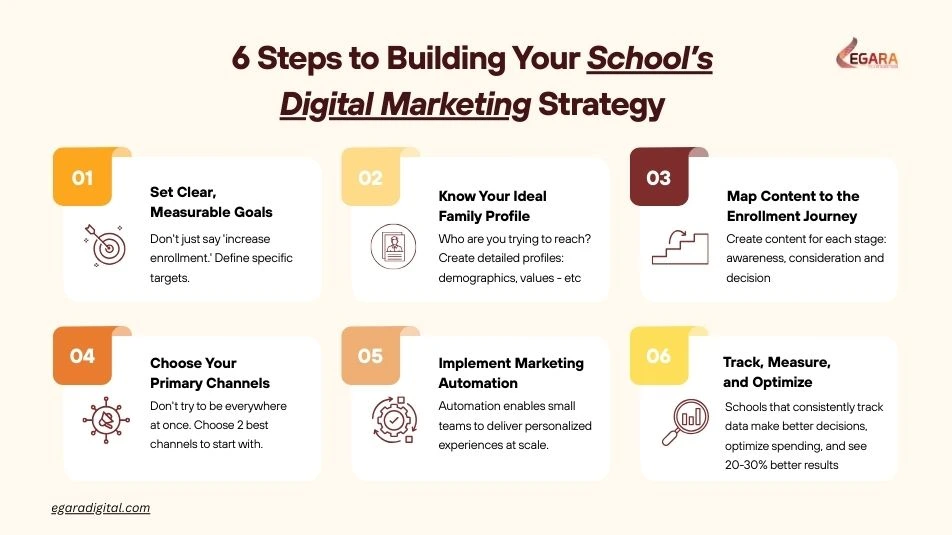
Having individual tactics is one thing; orchestrating them into a cohesive strategy is another. The most successful schools treat digital marketing as an integrated system where each channel supports the others.
Step 1: Set Clear, Measurable Goals
Don’t just say ‘increase enrollment.’ Define specific targets:
- Increase website inquiries by 40% by May
- Generate 200 qualified leads for fall enrollment
- Improve inquiry-to-application conversion rate from 30% to 45%
- Achieve 50% open rates on enrollment nurture emails
Step 2: Know Your Ideal Family Profile
Who are you trying to reach? Create detailed profiles:
- Demographics (location, income, family structure)
- Values and priorities (academics, faith, athletics, arts)
- Challenges and pain points (public school concerns, learning differences, schedule needs)
- Information-seeking behavior (where they search, what they read, who they trust)
Step 3: Map Content to the Enrollment Journey
Create content for each stage:
- Awareness: Blog posts on educational topics, comparison guides, program overviews
- Consideration: Virtual tours, detailed program pages, faculty bios, student testimonials
- Decision: Financial aid guides, application walkthroughs, parent FAQs, one-on-one consultations
Step 4: Choose Your Primary Channels
Don’t try to be everywhere at once. For most K-12 schools, prioritize:
- Website optimization (foundation)
- SEO (long-term organic growth)
- Facebook and Instagram (where parents spend time)
- Email marketing (highest ROI for nurturing)
- Google Ads during enrollment season (immediate visibility)
Also note that well-optimized local SEO landing pages allow schools to rank for searches like ‘best school in [area]’ or ‘private school near me’ and convert local families faster.
Step 5: Implement Marketing Automation
Automation enables small teams to deliver personalized experiences at scale:
- Automated inquiry responses within 5 minutes
- Drip campaigns nurturing prospects over weeks or months
- Event reminders and follow-ups
- Application deadline reminders
- Lead scoring to prioritize high-intent families
Step 6: Track, Measure, and Optimize
Set up comprehensive tracking:
- Google Analytics 4 for website behavior
- UTM parameters on all campaigns to track source
- CRM integration to track from inquiry to enrollment
- Monthly reporting on key metrics
Schools that consistently track data make better decisions, optimize spending, and see 20-30% better results than those who don’t measure performance.
The goal is not just traffic but to generate qualified leads —families who are genuinely interested, financially capable, and aligned with your school’s values.
Common Digital Marketing Mistakes Schools Make
Even with the best intentions, schools often stumble in predictable ways:
Treating the website as a static brochure:
Your website should be dynamic, regularly updated with fresh content, news, and timely information. A stale website signals a stagnant institution.
Using only stock photos:
Generic images undermine authenticity. Families can tell the difference between real student photos and stock imagery—and they trust real.
Slow response times:
When a family submits an inquiry, responding within 5-15 minutes dramatically increases conversion likelihood. Waiting 24-48 hours means they’ve likely already connected with competitors.
Inconsistent social media presence:
Posting once a month or abandoning accounts for weeks makes your school appear inactive. Consistency matters more than perfection.
Complicated inquiry and application processes:
Every additional form field reduces completion rates by 5-10%. Simplify wherever possible.
Ignoring mobile users:
More than 60% of traffic is mobile. If your forms, videos, and pages don’t work seamlessly on phones, you’re losing the majority of your audience.
Not tracking results:
You can’t improve what you don’t measure. Schools that don’t track which channels drive inquiries waste the budget on ineffective tactics.
Focusing solely on acquisition:
Re-enrollment and retention marketing are equally important. Don’t neglect your current families in pursuit of new ones.
Budget Allocation: Where to Invest Your Marketing Dollars
Most schools have limited marketing budgets, making smart allocation critical. Research shows successful schools typically invest 3-7% of their operating budget in marketing and admissions.
Recommended allocation for small to mid-sized schools:
- 30% Website and SEO: Foundation of all digital efforts
- 25% Paid Advertising: Google Ads and social media ads during peak seasons
- 20% Marketing Technology: CRM, email automation, analytics tools
- 15% Content Creation: Video production, photography, copywriting
- 10% Traditional Marketing: Direct mail, event materials, community partnerships
Adjust based on your specific situation. Schools in competitive markets may need higher paid advertising investment. Schools with strong word-of-mouth might invest more in content and less in paid channels.
Also, investing in smart local link building helps your school appear more authoritative in your city and improves your visibility in both Google search results and Maps.
Measuring Success: Key Metrics to Track
Track these essential metrics to evaluate digital marketing performance:
Website Metrics:
- Monthly unique visitors and page views
- Bounce rate (should be under 60%)
- Average session duration
- Form completion rate
Conversion Metrics:
- Inquiry form submissions per month
- Tour requests and attendance
- Application starts and completions
- Conversion rate from inquiry to application (target: 30-50%)
Channel Performance:
- Cost per inquiry by source
- Social media engagement rates
- Email open and click-through rates
- Paid ad conversion rates and ROI
Enrollment Metrics:
- Applications per enrollment spot
- Yield rate (accepted students who enroll)
- Cost per enrolled student
The Role of AI in School Digital Marketing
Artificial intelligence is transforming how schools market themselves. Recent data shows that 60% of students now use AI chatbots to research educational options, up from 49% just a year ago.
Practical AI applications for schools:
- 24/7 Chatbots: Answer common questions instantly, qualify leads, and schedule tours without human intervention. Modern AI chatbots can handle complex inquiries and provide personalized responses.
- Personalized Content: AI can customize website content, email messaging, and recommendations based on visitor behavior and stated interests.
- Predictive Analytics: Identify which inquiries are most likely to convert and prioritize follow-up accordingly.
- Content Creation: AI writing tools can draft blog posts, social media content, and email copy, freeing staff to focus on strategy and personal engagement.
- Video Production: AI editing tools dramatically speed up video production, making it feasible to create professional content regularly.
The schools that successfully integrate AI do so thoughtfully, using it to enhance human interactions rather than replace them. AI handles repetitive tasks, allowing staff to focus on relationship-building and personalized engagement.
How We Help Schools Succeed with Digital Marketing?
At Egara Digital, we specialize in helping educational institutions build comprehensive digital marketing strategies that drive enrollment and strengthen community engagement.
Our approach includes:
- Digital Marketing Audits: We analyze your current digital presence, identify gaps, and provide actionable recommendations for improvement.
- SEO for Educational Institutions: We optimize your website to rank for high-value keywords that prospective families are actively searching.
- Social Media Strategy and Management: We develop platform-specific strategies, create engaging content, and manage campaigns that build awareness and drive inquiries.
- Website Design and Optimization: We create mobile-responsive, conversion-focused websites that turn visitors into inquiries and applicants.
- Enrollment Marketing Campaigns: We design integrated campaigns across search, social, and email that guide families through the enrollment journey.
When schools start with digital marketing, they typically see 25-40% increase in qualified inquiries within the first enrollment season, along with improved conversion rates from inquiry to application.
Want to see where your school’s digital marketing can improve?
Getting Started: Your 90-Day Digital Marketing Action Plan
Ready to improve your school’s digital marketing? Here’s a practical 90-day plan to implement foundational improvements:
Days 1-30: Foundation
- Audit your current website and fix critical issues
- Claim and optimize Google Business Profile
- Set up Google Analytics 4 and conversion tracking
- Create or update Niche.com and GreatSchools profiles
- Document your ideal family profile
Days 31-60: Content and Presence
- Create or refresh 5 key web pages (programs, admissions, about, contact, FAQ)
- Develop 3 pieces of pillar content (blog posts or videos)
- Establish consistent social media posting schedule
- Set up automated inquiry response system
- Create welcome email sequence for new inquiries
Days 61-90: Amplification
- Launch targeted paid advertising campaign
- Implement monthly content calendar
- Begin monthly performance reporting
- Gather and promote parent testimonials
- Optimize based on first 60 days of data
Final Thoughts
Digital marketing for schools isn’t about following every trend or being on every platform. It’s about meeting prospective families where they are, providing the information they need, and making it easy for them to take the next step toward joining your community.
The schools that succeed understand that digital marketing is a marathon, not a sprint. They invest consistently, measure diligently, and optimize continuously. They prioritize authentic storytelling over perfect polish, and they recognize that every digital touchpoint is an opportunity to demonstrate the value they provide to students and families.
Whether you’re a small private school competing for enrollment, a public charter building awareness, or a higher education institution recruiting nationally, the principles remain the same: be findable, be helpful, be authentic, and be responsive.
Start where you are. Use what you have. Do what you can. Small, consistent improvements compound over time into significant competitive advantages.