

Every day, homeowners in your service area pull out their phones and search for contractors just like you. The question isn’t whether they’re searching—it’s whether they’re finding you or your competitor.
Over 97% of homeowners now use Google to find local home services and general contractors, and 75% of potential clients never scroll past page one of Google. If your business isn’t showing up in those top positions, you’re essentially invisible to the most valuable prospects in your market.
The good news? You don’t need to be a marketing wizard to rank higher on Google. You just need a strategic SEO approach tailored specifically for general contractors. This comprehensive guide will show you exactly how to build an online presence that turns local searches into booked jobs and consistent revenue.
What Is SEO for General Contractors?
SEO (Search Engine Optimization) for general contractors is the practice of optimizing your online presence to appear prominently when homeowners and businesses search for construction services in your area. It’s about making your business discoverable exactly when someone needs your expertise.
Unlike traditional advertising that broadcasts your message to everyone regardless of interest, SEO connects you with people actively searching for your specific services. These are warm leads already interested in hiring a contractor, making them far more likely to convert into paying customers.
Think of SEO as your digital business card that works around the clock. When someone types phrases like “general contractor near me,” “kitchen remodeling in Chicago,” or “home addition builder,” SEO determines whether your business appears at the top of those search results or gets buried on page ten where almost no one looks.
The beauty of contractor SEO is that it aligns with how people naturally search. Rather than interrupting potential clients with ads, you position your business to be found precisely when they need you. It’s the difference between hoping someone sees your billboard and ensuring they find you when they’re ready to hire.
Partnering with an experienced seo agency in India can simplify this entire process and help you avoid costly trial-and-error while scaling your rankings faster.
Why SEO Matters More Than Ever for General Contractors?
The construction industry has fundamentally shifted. Word-of-mouth and yard signs alone no longer fill your pipeline. According to recent reports, 96% of people learn about local businesses online, and that includes contractors.
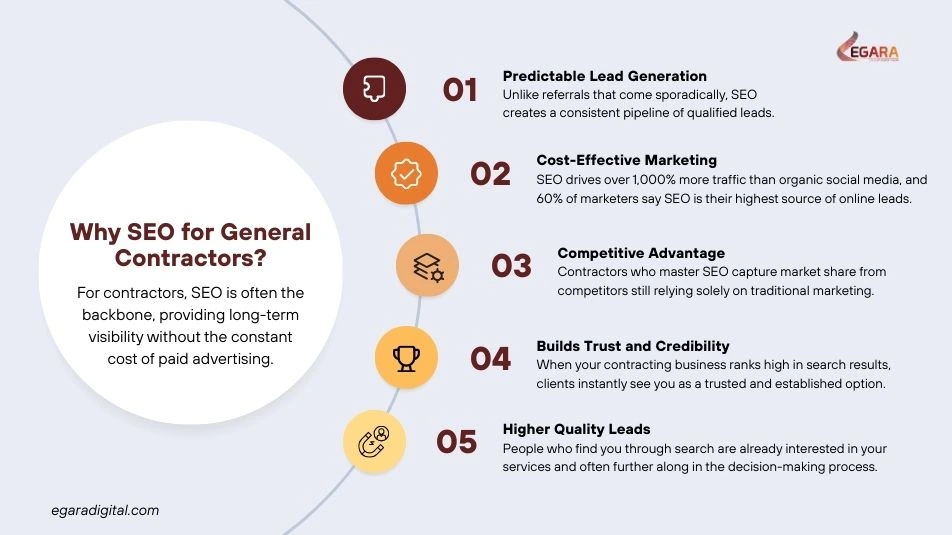
For contractors, SEO is often the backbone of digital marketing for small business, providing long-term visibility without the constant cost of paid advertising.
Here’s why investing in SEO has become essential rather than optional:
Predictable Lead Generation
Unlike referrals that come sporadically, SEO creates a consistent pipeline of qualified leads. Once you rank well for relevant keywords, you receive steady traffic from people actively searching for construction services in your area.
Cost-Effective Marketing
SEO drives over 1,000% more traffic than organic social media, and 60% of marketers say SEO is their highest source of online leads. After the initial investment, SEO continues delivering results without the ongoing costs of pay-per-click advertising.
Competitive Advantage
In crowded local markets, contractors who master SEO capture market share from competitors still relying solely on traditional marketing. Being visible when prospects search gives you first-mover advantage in the buying process.
Builds Trust and Credibility
When potential clients see your contracting business ranking highly for relevant searches, they instantly perceive you as an established, trustworthy option. This digital first impression can be incredibly powerful in an industry where trust is everything.
Higher Quality Leads
People who find you through search are already interested in your services and often further along in the decision-making process. These targeted leads convert at higher rates than cold prospects from traditional advertising.
The contractors who take SEO seriously are the ones getting found, getting calls, and getting paid. Those who ignore it are leaving money on the table every single day.
Understanding How Google Ranks General Contractors
Before diving into specific tactics, it’s helpful to understand what Google looks for when determining which contractors to show in search results.
Google’s local ranking algorithm considers three primary factors:
Relevance:
How well does your business match what someone is searching for? Google analyzes your website content, business categories, and profile information to determine if you’re a good fit for specific queries.
Distance:
How close is your business to the person searching? For service-area businesses like general contractors, Google considers both your physical location and the service areas you’ve specified.
Prominence:
How well-known and reputable is your business? Google evaluates factors like review quantity and quality, backlinks from other websites, and overall online presence to determine authority.
Understanding these factors helps explain why some contractors dominate search results while others struggle. The strategies in this guide address all three ranking factors systematically.
The Foundation: Optimizing Your Google Business Profile
Your Google Business Profile (formerly Google My Business) is the single most important element of local SEO for general contractors. This free listing controls how you appear in Google Maps and local search results.
Strong local visibility starts with proper google business profile optimization, which directly impacts your ability to rank in Google Maps and local search results.
People who find a business through a Google Business Profile listing are up to 50% more likely to convert into paying customers. That’s why optimizing this profile should be your first priority.
Claiming and Verifying Your Profile
If you haven’t already claimed your profile, search for your business name on Google and click “Claim this business” or create a new profile at google.com/business. Google will verify ownership through mail, phone, or email.
Verification tells Google you’re authorized to represent the business, making you more likely to appear in relevant search results.
Completing Every Profile Section
Keep your NAP (Name, Address, Phone number) consistent, as even small differences like “Street” versus “St.” matter. Use the same exact business information across your website and all online directories.
Select the most accurate primary category. “General Contractor” should be your main category, with secondary options like “Kitchen Remodeler,” “Home Builder,” or “Bathroom Remodeler” if they apply.
Write a compelling business description that naturally incorporates keywords while explaining what makes your contracting business unique. Include your service area, specialties, and years of experience.
Adding High-Quality Photos
Visual content dramatically impacts conversion rates. Upload photos showing:
- Completed projects with before-and-after comparisons
- Your team at work demonstrating professionalism
- Satisfied clients (with permission)
- Your vehicles and equipment
- Your office or shop if applicable
Update photos regularly to show recent work. Geo-tagged photos from job sites help strengthen local relevance.
Managing and Responding to Reviews
In 2025, over 90% of homeowners read reviews, and Google uses them to decide who shows up in search. Make review generation and management a core part of your process.
After completing each project, ask satisfied clients to leave a review on your Google Business Profile. Make it easy by sending them a direct link to your review page.
For better SEO, ask customers to mention what service you provided and where, such as “John remodeled my kitchen in Westlake”. This adds valuable keyword signals.
When you receive a negative review, respond professionally and promptly. Show potential clients that you’re someone who takes responsibility and fixes issues. A thoughtful response to criticism can actually build trust.
Using Google Posts
Google Posts allow you to share updates, promotions, and project highlights directly in your Business Profile. While posts only last seven days, using them regularly signals to Google that you’re actively managing your listing.
Share completed projects, seasonal promotions, helpful tips for homeowners, or announcements about your services. These posts create additional engagement opportunities and can improve your visibility.
Not sure where your SEO is leaking revenue
Get clarity with our Free 3-Point Revenue Opportunity Audit.
Building a High-Converting Contractor Website
Your website serves as your digital headquarters where prospects learn about your services, view your portfolio, and ultimately decide whether to contact you. An effective contractor website balances SEO optimization with user experience.
Clear Site Structure and Navigation
Organize your website so both visitors and search engines can easily understand what you offer. A typical structure includes:
- Homepage: Introduces your company and can rank for general searches like “general contractor [your city].” Clearly communicate your value proposition, service area, and what sets you apart.
- About Us: Builds trust by sharing your story, certifications, insurance information, and why clients should choose you. Include photos of your team and leadership.
- Services Pages: Create dedicated pages for each major service you offer. Homeowners typically search one service at a time, so separate pages help Google match you with those specific queries.
- Portfolio/Projects: Showcase completed work with high-quality photos, project descriptions, and client testimonials. This visual proof builds credibility and gives prospects confidence in your capabilities.
- Service Area: Clearly define where you work. For contractors serving multiple cities, create location-specific pages (more on this below).
- Contact: Make it simple for leads to reach you with phone numbers, email, contact forms, and office address if applicable.
- Blog: Publish helpful content addressing common questions and concerns. This establishes expertise and targets informational keywords.
List your main services clearly in your website menu so visitors can click straight to what they need.
Local Keyword Optimization
Keywords are the phrases people type into search engines when looking for contractors. Your website needs to target the specific terms your ideal clients use.
Instead of targeting broad terms, focus on long-tail keywords like “affordable roofing contractor in Austin” or “emergency plumber in Chicago” as these usually have lower competition and higher conversion rates because they reflect clear user intent.
For general contractors, effective keywords combine your service with your location:
- “General contractor [city name]”
- “Kitchen remodeling [city name]”
- “Bathroom renovation [city name]”
- “Home additions [neighborhood]”
- “Basement finishing near me”
Use keyword research tools like Google Keyword Planner, Ahrefs, or Semrush to identify terms with decent search volume and reasonable competition. Look for keywords that indicate buying intent rather than just information-gathering.
Once you’ve identified target keywords, incorporate them naturally into:
- Page titles and meta descriptions
- Heading tags (H1, H2, H3)
- First paragraph of body content
- Image alt text
- URLs
Avoid keyword stuffing, which harms rather than helps your rankings. Write naturally for humans while including relevant terms where they make sense.
Creating Service-Specific Pages
Every service you offer deserves its own dedicated page. A common mistake is listing all services on a single page, which dilutes your ability to rank for any of them.
Each service page should include:
- Clear description of the service and what it involves
- Benefits to homeowners
- Your process and timeline
- Pricing guidance (even if just ranges)
- Portfolio examples of that specific service
- Client testimonials related to that service
- Answers to frequently asked questions
- Strong call-to-action (phone number, contact form, request quote button)
Optimize each page for its primary keyword. For example, your kitchen remodeling page should target “kitchen remodeling [city]” throughout the content.
Location-Specific Pages
If you serve multiple cities or regions, create separate location pages to capture searches in each area. This is one of the most powerful tactics in local SEO for contractors.
Each location page should include:
- Service descriptions tailored to that area
- Local landmarks and neighborhoods you serve
- Projects you’ve completed in that location
- Testimonials from clients in that area
- Unique content (not duplicated across location pages)
Target keywords like “[service] in [city]” or “[city] [service] contractor” on these pages. Include the location in headings, content, and meta information.
These location-specific pages act as high-converting local landing pages that help you rank for service + city searches and convert visitors into inquiries.
Mobile Optimization
Most homeowners search for contractors on their smartphones, often when they’re ready to hire immediately. If your website doesn’t work well on mobile devices, you’re losing leads.
Ensure your website:
- Loads quickly on mobile connections
- Has readable text without zooming
- Features easily clickable buttons and phone numbers
- Simplifies navigation for small screens
- Uses responsive design that adapts to any device
Google prioritizes mobile-friendly websites in search rankings, making mobile optimization essential for both user experience and SEO.
Website Speed and Technical SEO
If your website loads slower than a backhoe in reverse, it’s time for a refresh. Page speed directly impacts both user experience and search rankings.
Technical improvements include:
- Compressing images without losing quality
- Minimizing code and scripts
- Using browser caching
- Implementing a content delivery network (CDN)
- Ensuring secure HTTPS connection
- Adding schema markup so Google understands your business type, service area, and offerings
If technical SEO feels overwhelming, hire a developer or agency to handle the backend while you focus on running your business.
Already doing SEO but not seeing real leads?
Our 3-Point Revenue Opportunity Audit will show you exactly why.
Keyword Research for General Contractors
Effective keyword targeting starts with understanding what your ideal customers actually search for. Put yourself in their shoes: What would you type into Google if you needed a contractor?
Types of Keywords to Target
- Transactional Keywords: These indicate someone ready to hire. Examples include “hire general contractor Chicago,” “general contractor near me,” or “get quote kitchen remodel.” These should be your highest priority.
- Commercial Investigation Keywords: These show someone comparing options. Examples include “best general contractor Austin,” “top-rated home remodelers,” or “licensed contractors [city].”
- Informational Keywords: These target people earlier in the research phase. Examples include “how much does kitchen remodeling cost,” “home addition ideas,” or “bathroom renovation timeline.”
Each keyword type matches a stage of the buyer’s journey—awareness, interest, desire, or action. The better you match intent, the higher and faster you’ll rank.
Finding the Right Keywords
Start with a seed list of terms related to your services and location. Use keyword research tools to expand this list and identify:
- Search volume (how many people search for this term)
- Keyword difficulty (how competitive it is to rank)
- Related keywords and questions people ask
Look for the sweet spot: keywords with reasonable search volume, manageable competition, and clear buying intent.
Don’t ignore “near me” searches and location-specific variations. Mobile searchers frequently use phrases like “general contractor near me” or just “general contractor” when searching from their location.
Organizing Keywords by Page
Map keywords to specific pages on your website:
- Homepage: General brand terms and broad service keywords
- Service pages: Specific service keywords
- Location pages: Service + location combinations
- Blog posts: Informational and question-based keywords
This strategic organization ensures each page has a clear purpose and target audience.
Creating Content That Ranks and Converts
Content marketing helps you rank for informational keywords, establish expertise, and guide prospects through the decision-making process. For general contractors, effective content addresses the questions homeowners ask before hiring.
Starting a Contractor Blog
A blog serves multiple SEO purposes:
- Targets informational keywords that attract early-stage prospects
- Demonstrates expertise and builds trust
- Provides fresh content that signals activity to Google
- Creates shareable assets for social media
- Offers email newsletter material for nurturing leads
Blog topics for general contractors include:
- Project guides (“Complete Guide to Kitchen Remodeling”)
- Cost breakdowns (“How Much Does a Bathroom Renovation Cost in [City]?”)
- Design trends (“Top Home Addition Trends for 2025”)
- Process explanations (“What to Expect During a Home Remodel”)
- Maintenance tips (“Extending the Life of Your New Deck”)
- Before-and-after case studies
Write in a clear, approachable style. Most homeowners aren’t construction experts, so avoid jargon and explain concepts simply.
Using Visual Content
Construction is a highly visual industry. Leverage photos and videos to showcase your work:
- Project galleries with detailed before-and-after comparisons
- Video walkthroughs of completed renovations
- Time-lapse videos of construction processes
- Client testimonial videos
- Virtual tours of newly built spaces
Optimize visual content by:
- Adding descriptive alt text to images
- Including captions with relevant keywords
- Compressing files for fast loading
- Hosting videos on YouTube to expand your reach
- Embedding videos on relevant website pages
Answering Common Questions
Create content addressing the questions prospects ask during their research:
- “How do I choose a general contractor?”
- “What questions should I ask before hiring?”
- “How long does a typical remodel take?”
- “Do I need permits for home renovations?”
- “What’s included in a contractor estimate?”
These question-based articles can rank for voice searches and featured snippets, increasing your visibility.
Building Local Citations and Directory Listings
Local citations are online mentions of your business name, address, and phone number across various directories and websites. These citations reinforce to Google that your business is legitimate and serves specific locations.
Essential Directories for Contractors
Ensure your business is listed accurately on:
General Directories:
- Yelp
- Yellow Pages
- Better Business Bureau
- Angi (formerly Angie’s List)
- HomeAdvisor
- Thumbtack
Industry-Specific Platforms:
- Houzz
- Porch
- BuildZoom
- Associated General Contractors (AGC)
Local Directories:
- Chamber of Commerce listings
- Local business associations
- Community websites
- Local news sites
Maintaining NAP Consistency
A common mistake contractors make is neglecting consistency, leaving outdated addresses or phone numbers in some directories. These small details create doubt and can lead potential clients to choose a competitor who’s easier to contact.
Use identical formatting across all platforms:
- Business name exactly as it appears legally
- Complete address with consistent abbreviations
- Same phone number everywhere
- Matching website URL
Regular audits ensure your information stays aligned across all digital channels. Consider using citation management tools to monitor and update listings efficiently.
Want predictable local leads instead of guesswork?
Start with a Free 3-Point Revenue Opportunity Audit.
Earning Quality Backlinks
Backlinks are links from other websites pointing to yours. Google views backlinks as votes of confidence—the more quality sites linking to you, the more authoritative you appear.
For contractors, local link building is especially powerful because it signals geographic relevance and trust to Google, helping you dominate city-based search results.
Strategies for Building Backlinks
Local Business Partnerships:
Partner with complementary businesses like architects, interior designers, real estate agents, and home inspectors. They can link to your website, and you can link to theirs.
Supplier Relationships:
Many building material suppliers and manufacturers maintain contractor directories or case study pages. Ask suppliers you work with regularly to feature your business.
Industry Associations:
Join construction industry organizations like the Associated General Contractors, National Association of Home Builders, or local trade groups. Membership often includes a website listing.
Local Media Coverage:
Reach out to local newspapers, magazines, and blogs about interesting projects you’ve completed, community involvement, or expert commentary on construction topics.
Guest Posting:
Write articles for local business blogs, home improvement websites, or community publications. Include a link back to your website in your author bio.
Sponsorships and Events:
Sponsor local events, sports teams, or charities. These organizations typically list sponsors on their websites with links.
Project Showcases:
Platforms like Houzz and Porch feature contractor work. Complete your profiles and showcase projects to earn backlinks from these authoritative sites.
Focus on quality over quantity. A single link from a respected local news site carries more weight than dozens of links from low-quality directories.
Leveraging Online Reviews for SEO
Reviews don’t just influence potential clients—they directly impact search rankings. Research shows 87% of people won’t consider a business unless it has three to five-star reviews, and construction websites with ideal review ratings have higher click-through rates and rankings.
Implementing a Review Generation System
The best time to ask for a review is immediately after completing a project successfully. Build review requests into your standard process:
- Complete the project to the client’s satisfaction
- Send a thank-you email expressing appreciation for their business
- Include a direct link to your Google Business Profile review page
- Make it easy with clear instructions
- Follow up once if they haven’t left a review after a week
Consider offering small incentives like entry into a quarterly gift card drawing for clients who leave reviews (but never pay for positive reviews, which violates platform policies).
Responding to All Reviews
Reply to every review, both positive and negative. Thank clients for positive feedback and address any concerns raised in negative reviews professionally.
Your responses show potential clients how you handle feedback and demonstrate commitment to customer satisfaction. Even negative reviews can become opportunities to showcase your professionalism.
Expanding Beyond Google
While Google reviews are most important for SEO, diversify your review presence across:
- Yelp
- Houzz
- Angi
- Better Business Bureau
Reviews on multiple platforms increase your overall online reputation and provide additional ranking signals.
Tracking and Measuring SEO Success
SEO isn’t just about traffic—it’s about learning how to generate qualified leads that turn into booked projects and consistent revenue.
SEO without tracking is like building without blueprints. You need to monitor performance to understand what’s working and where to focus improvement efforts.
Key Metrics to Monitor
- Rankings: Track where you rank for target keywords. Use tools like Google Search Console, Ahrefs, or Semrush to monitor position changes over time.
- Organic Traffic: Measure how many people visit your website from search engines. Google Analytics shows traffic sources, pages visited, and user behavior.
- Conversion Rate: Track how many website visitors take desired actions like calling, filling out contact forms, or requesting quotes. This matters more than raw traffic numbers.
- Local Visibility: Monitor how often your Google Business Profile appears in local searches and how many people click through to your website or call directly.
- Leads Generated: Count qualified leads attributable to SEO efforts. Compare cost-per-lead from SEO versus other marketing channels.
- Revenue Attribution: Track which clients found you through search and calculate the total revenue from SEO-generated leads.
Using Google Analytics and Search Console
Set up Google Analytics to track website traffic, user behavior, and conversions. Create goals for phone clicks, form submissions, and other important actions.
Google Search Console shows which search queries trigger your website to appear in results, your average ranking position, and technical issues affecting performance.
Review these dashboards monthly to identify trends, opportunities, and problems requiring attention.
Adjusting Your Strategy
SEO isn’t set-and-forget. Use data insights to refine your approach:
- Double down on keywords driving qualified leads
- Improve or remove underperforming content
- Identify new keyword opportunities
- Address technical issues impacting rankings
- Experiment with new content formats and topics
Successful SEO requires ongoing optimization based on performance data.
Advanced SEO Strategies for Competitive Markets
Once you’ve implemented the foundational tactics, these advanced strategies can help you outrank established competitors.
Schema Markup
Schema markup is code added to your website that helps search engines understand your content better. For contractors, local business schema provides structured information about:
- Business name, address, and phone number
- Service areas
- Operating hours
- Services offered
- Reviews and ratings
Implementing schema can improve your appearance in search results and increase click-through rates. If you’re not comfortable adding code to your website, hire a developer to implement it.
Video SEO
Video content is increasingly important in search results. Create videos for:
- Project showcases and tours
- Customer testimonials
- Educational how-to content
- Company introductions
Upload videos to YouTube (the second-largest search engine) with optimized titles, descriptions, and tags. Then embed relevant videos on your website pages to enhance content and user engagement.
Voice Search Optimization
Voice searches through smartphones and smart speakers are growing rapidly. Optimizing your site for long-tail keywords can improve your chances of ranking for voice searches.
Voice queries tend to be longer and more conversational than typed searches. Optimize for natural language questions:
- “Who’s the best general contractor near me?”
- “How much does a kitchen remodel cost in Austin?”
- “What contractors do bathroom renovations in Chicago?”
Create FAQ pages and blog content that answers these conversational queries directly.
Competitor Analysis
Study what’s working for contractors ranking above you. Analyze their:
- Target keywords and content topics
- Website structure and user experience
- Backlink sources
- Google Business Profile optimization
- Review quantity and quality
Identify gaps in their strategy and opportunities where you can differentiate or outperform them.
Common SEO Mistakes Contractors Make
Avoid these frequent pitfalls that undermine SEO effectiveness:
Neglecting Mobile Users
With most searches happening on smartphones, a poor mobile experience kills conversions even when you rank well.
Inconsistent NAP Information
Different business information across platforms confuses both Google and potential clients.
Ignoring Reviews
Failing to actively generate and respond to reviews handicaps local rankings and erodes trust.
Targeting Wrong Keywords
Chasing high-volume keywords with low buying intent wastes effort. Focus on keywords indicating hiring readiness.
Duplicate Content
Using identical content across multiple location pages or service pages prevents any of them from ranking well.
Slow Website
Long loading times frustrate users and harm rankings. Compress images and optimize code for speed.
No Clear Calls-to-Action
Ranking well doesn’t matter if visitors can’t easily figure out how to contact you. Make phone numbers and contact forms prominent.
Giving Up Too Soon
SEO typically takes 3-6 months to show significant results. Many contractors abandon efforts just before they would have gained traction.
Not sure where your SEO is leaking revenue?
Get clarity with our Free 3-Point Revenue Opportunity Audit.
Putting It All Together: Your SEO Action Plan
Implementing comprehensive SEO might feel overwhelming, but you can build momentum by prioritizing high-impact activities.
Month 1: Foundation
- Claim and optimize your Google Business Profile
- Ensure NAP consistency across all existing online listings
- Implement mobile-friendly, fast-loading website
- Create or improve core website pages (homepage, about, services, contact)
- Set up Google Analytics and Search Console
Month 2-3: Content and Optimization
- Develop dedicated service pages for each offering
- Create location pages if you serve multiple cities
- Research and document target keywords
- Optimize existing pages with relevant keywords
- Begin systematic review collection process
- Start publishing blog content addressing customer questions
Month 4-6: Building Authority
- Submit to relevant local and industry directories
- Reach out to local businesses for partnership opportunities
- Create case studies and project showcases
- Expand content library with more blog posts
- Monitor analytics and adjust strategy based on performance
- Build backlinks through local partnerships and media outreach
Ongoing Maintenance
- Publish new blog content regularly (at least 2-4 times monthly)
- Update Google Business Profile with posts and photos
- Respond to all reviews promptly
- Monitor rankings and traffic trends
- Refresh older content to keep it current
- Continue building relationships for backlink opportunities
Conclusion: Your Digital Foundation for Growth
The construction industry is more competitive than ever, and the contractors who master digital marketing will dominate their markets. SEO isn’t just another marketing expense—it’s the foundation for sustainable, predictable growth.
While contractors spend 40+ hours a week on crews and jobs and juggle 60-80 projects a year, taking time to build your online presence pays dividends for years to come. Done right, SEO cuts advertising costs, keeps leads flowing, and positions you as the trusted authority in your area.
Start with the fundamentals: claim your Google Business Profile, build a solid website, and begin collecting reviews. Then layer in content creation, local citations, and backlink building over time.
Remember, your next high-value client is searching for you right now. The question is whether they’ll find you or your competitor.
If you’re looking for a growth-focused digital marketing agency in India that understands how SEO translates into real revenue, Egara Digital is ready to help.
Our Free 3-Point Revenue Opportunity Audit analyzes your current online presence and shows you exactly:
✓ Where you’re losing leads to competitors in local search
✓ What’s broken in your digital marketing foundation
✓ How to fix it with a prioritized action plan
Stop guessing. Get the clarity you need to dominate local search and fill your pipeline with ready-to-hire homeowners.