

Every sales leader knows the frustration of an inconsistent pipeline. While inbound marketing attracts qualified prospects, it doesn’t always move fast enough to hit aggressive growth targets. That’s where outbound lead generation becomes your secret weapon.
In 2026, outbound isn’t about spray-and-pray tactics or generic mass emails. It’s evolved into a precision-driven system that combines smart targeting, personalization at scale, and multi-channel orchestration to consistently fill your pipeline with qualified opportunities.
This comprehensive guide will walk you through everything you need to know about modern outbound lead generation, proven strategies that work today, and real-world examples to inspire your next campaign.
What Is Outbound Lead Generation?
Outbound lead generation is the proactive process of identifying and reaching out to potential customers who haven’t yet shown interest in your product or service. Unlike inbound marketing, where prospects find you, outbound means you initiate the conversation.
Many companies also partner with a specialized SEO agency in India to ensure inbound demand compounds alongside outbound pipeline efforts.
The core principle is simple: identify high-potential prospects, reach out with relevant messaging, and guide them through your sales funnel.
When executed properly, outbound lead generation gives you direct control over your pipeline growth rather than waiting for leads to discover you.
Modern outbound strategies rely on three critical elements:
- Precise Targeting: Using firmographic data, intent signals, and ideal customer profiles to identify accounts most likely to convert
- Personalized Messaging: Creating relevant outreach that addresses specific pain points rather than generic sales pitches
- Consistent Execution: Building multi-channel sequences that maintain presence without overwhelming prospects
The fundamental difference between outbound and inbound lies in who initiates contact.
Inbound focuses on attracting leads through valuable content, SEO, and optimized local SEO landing page strategies that help businesses capture high-intent local searches.
Outbound takes the direct approach through cold calling, email campaigns, LinkedIn outreach, and targeted advertising.
Why Outbound Lead Generation Still Matters in 2026?
Despite the rise of content marketing and inbound strategies, outbound remains essential for several compelling reasons:
Accelerated Pipeline Growth:
Outbound delivers results faster than waiting for organic traffic and inbound conversions. When you need to fill your pipeline quickly, proactive outreach generates immediate conversations.
Expanded Market Reach:
You can tap into new markets and customer segments that might never discover you through inbound channels alone. This is particularly valuable when launching new products or entering unfamiliar territories.
Many owners combine outbound with strong digital marketing for small business strategies to build both short-term pipeline and long-term brand visibility.
Predictable Revenue:
A well-executed outbound system creates forecasting certainty. You control the volume of outreach, which directly impacts the number of conversations and ultimately closed deals.
Competitive Advantage:
In crowded markets, waiting for prospects to find you means competitors might reach them first. Outbound lets you proactively engage decision-makers before they even begin their buying journey.
Industry data shows that teams embracing modern outbound tactics—omnichannel approaches, smarter targeting, and personalization at scale—continue booking meetings and closing deals, even as generic mass outreach becomes less effective.
Struggling to Build A Predictable Pipeline?
Building Your Outbound Lead Generation Strategy
Success in outbound starts with a strategic foundation. Here’s how to build an outbound system that consistently delivers qualified leads.
Define Your Ideal Customer Profile
Your Ideal Customer Profile (ICP) is the foundation of effective targeting. This goes beyond basic firmographics like company size and industry. In 2026, sophisticated ICPs include:
- Firmographic Criteria: Industry, company size, revenue range, geographic location, and growth stage
- Technographic Data: Current technology stack, recent software purchases, and digital maturity indicators
- Behavioral Signals: Hiring velocity, funding rounds, leadership changes, and other buying triggers
- Pain Points and Priorities: Specific challenges your solution addresses and business initiatives that align with your value proposition
Don’t treat your ICP as a static document. Top-performing teams revisit and refine their ICP quarterly based on which accounts actually convert into customers. Segment your ICP by priority tiers to focus resources on the highest-value opportunities.
Develop Targeted Buyer Personas
Within your ICP, you’ll engage multiple decision-makers and influencers. Buyer personas help you tailor messaging to resonate with different roles:
- Economic buyers who control budget decisions
- Technical evaluators who assess product capabilities
- Champions who advocate internally for your solution
- End users who will actually use your product
Understanding each persona’s priorities, objections, and preferred communication channels enables you to craft messages that speak directly to their needs. In B2B sales, the average buying committee includes 10-11 people, making multi-threading across personas essential for deal success.
Set Clear Goals and KPIs
Establish specific, measurable objectives for your outbound program. Common KPIs include:
- Activity Metrics: Emails sent, calls made, LinkedIn connections, touchpoints per sequence
- Engagement Metrics: Open rates, reply rates, positive response percentage, meeting booking rate
- Conversion Metrics: MQL to SQL conversion rate, SQL to opportunity rate, opportunity to closed-won rate
- Pipeline Metrics: Pipeline value generated, average deal size, sales cycle length
Track these metrics to identify bottlenecks and continuously optimize your approach. The goal isn’t just generating activity; it’s creating meaningful conversations that advance deals.
Choose Your Outbound Channels
Modern outbound success requires a multi-channel approach. The most effective channels for B2B outbound lead generation include:
- Cold Email: Remains the workhorse of outbound, offering scalability and personalization capabilities. When executed with research-backed personalization and value-focused messaging, cold email still drives strong response rates.
- Cold Calling: Provides real-time interaction and immediate feedback. While challenging, calls remain highly effective for engaging senior decision-makers who rarely respond to emails.
- LinkedIn Outreach: Essential for B2B sales, allowing you to build relationships through profile engagement, connection requests, and direct messages. LinkedIn Sales Navigator enables advanced targeting and prospecting.
- Video Messaging: Creates personal connections that text-based outreach can’t match. Short, personalized video introductions stand out and demonstrate genuine effort.
- Direct Mail: Physical touchpoints surprise prospects in an increasingly digital world. Strategic direct mail campaigns can breakthrough crowded inboxes.
Don’t try to master every channel at once. Start with two to three channels where your prospects are most active, then expand as you build capability and resources.
7 Proven Outbound Lead Generation Strategies
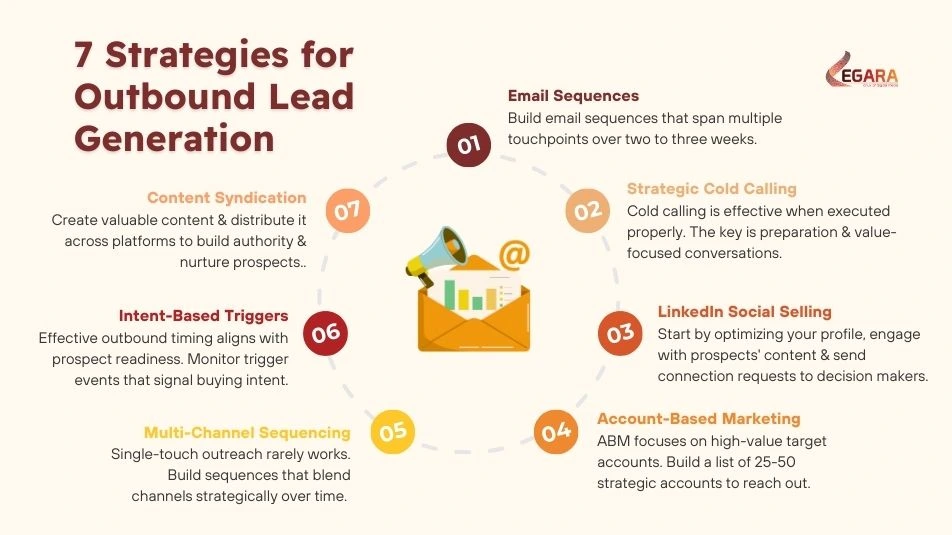
Let’s explore the tactics that separate high-performing outbound teams from those struggling to generate pipeline.
1. Hyper-Personalized Email Sequences
Generic email blasts died years ago. Today’s buyers expect relevance, and personalization directly impacts response rates. Research shows that personalized outreach improves conversions by 37%.
Effective personalization goes beyond inserting a first name. Reference recent company news, industry challenges, mutual connections, or specific initiatives visible on their website.
Use AI-powered research tools to gather prospect intelligence at scale, then craft messaging that demonstrates you understand their specific situation.
Build email sequences that span multiple touchpoints over two to three weeks. Each message should add new value—whether sharing a relevant insight, case study, or helpful resource—rather than simply repeating your initial pitch.
2. Strategic Cold Calling
Despite predictions of its demise, cold calling remains highly effective when executed properly. The key is preparation and value-focused conversations.
Before dialing, research each prospect thoroughly. Understand their role, company priorities, and potential pain points.
Lead your calls with insight rather than product features. Ask thoughtful questions that demonstrate industry knowledge and genuine interest in their challenges.
Time your calls strategically. Early mornings and late afternoons typically see better connection rates. Use your prospect’s time zone and test different calling windows to optimize contact rates.
3. LinkedIn Social Selling
LinkedIn has become indispensable for B2B outbound. Start by optimizing your profile as a valuable resource. Your headline, summary, and activity should position you as a helpful industry expert rather than just another salesperson.
Engage with prospects’ content before sending connection requests. Comment thoughtfully on their posts, share valuable insights, and build familiarity. When you do reach out, reference specific content they’ve shared or mutual interests.
LinkedIn Sales Navigator provides advanced filtering to identify decision-makers at target accounts. Use it to map buying committees and coordinate outreach across multiple stakeholders.
Businesses working with a professional social media marketing agency often see better engagement results because messaging and positioning stay consistent across platforms.
4. Account-Based Marketing (ABM) Campaigns
ABM focuses resources on high-value target accounts rather than casting a wide net. Build lists of 25-50 strategic accounts, then orchestrate coordinated campaigns across multiple channels and stakeholders.
Successful ABM campaigns combine personalized emails, targeted LinkedIn engagement, customized content, and sometimes physical touchpoints like direct mail. The goal is creating multiple engagement opportunities that build brand awareness and trust before your sales conversation.
One SaaS company ran a 50-account ABM campaign using email, LinkedIn, and direct mail over three weeks, achieving a 28% positive reply rate—significantly higher than traditional broad outreach.
5. Multi-Channel Sequencing
Single-touch outreach rarely works. Top performers build sequences that blend channels strategically over time. A sample cadence might include:
- Day 1: Personalized email introducing yourself and value proposition
- Day 3: LinkedIn connection request with personal note
- Day 5: Follow-up email sharing relevant resource or insight
- Day 7: Phone call attempt
- Day 10: Video message addressing potential objections
- Day 14: Final email with clear call-to-action
Spacing touchpoints prevents overwhelming prospects while maintaining presence. Each interaction should add value and provide a different angle or piece of information.
6. Intent-Based Trigger Campaigns
The most effective outbound timing aligns with prospect readiness. Monitor trigger events that signal buying intent or urgency:
- Company Growth: Funding announcements, hiring spikes, new office locations
- Leadership Changes: New executives often evaluate existing vendors and processes
- Technology Changes: Software purchases that complement your solution
- Market Shifts: Regulatory changes or competitive moves creating urgent needs
Build automated workflows that alert your team to these triggers, then reach out with highly relevant messaging that connects your solution to the specific event.
7. Content Syndication and Thought Leadership
While primarily an inbound tactic, content can supercharge outbound effectiveness. Create valuable content addressing your ICP’s challenges, then proactively share it with prospects as a conversation starter.
Successful content syndication involves repurposing high-performing content across channels. Turn blog posts into LinkedIn articles, YouTube videos, podcast episodes, or downloadable resources. Then use this content to provide value during outreach sequences.
Not Sure which Outbound Strategy will Actually Work for You?
Real-World Outbound Lead Generation Examples
Seeing strategies in action makes them more tangible. Here are proven examples across industries:
Professional Services Consulting
Outbound strategies also work extremely well for niche service businesses. For example, agencies applying targeted outreach and digital marketing strategies for interior designers have successfully helped studios book high-value projects consistently.
B2B SaaS Platform
A software company built a 50-account ABM list and executed a three-week multi-channel sequence combining email, LinkedIn engagement, and creative direct mail. The campaign delivered a 28% positive reply rate and generated over $2M in qualified pipeline.
Commercial Real Estate
A commercial real estate firm used trigger-based outreach, monitoring business expansion announcements and leadership changes. When prospects signaled growth, they reached out with market intelligence and space availability aligned to the company’s expansion plans.
Similar outbound and SEO combinations have proven effective in local industries, including construction firms investing in SEO for general contractors to generate steady project inquiries.
Financial Services:
A fintech company leveraged video messaging to stand out in crowded executive inboxes. Sales reps sent personalized 60-second videos addressing specific challenges visible in the prospect’s business. This approach boosted meeting booking rates by 40% compared to text-only outreach.
These examples share common elements: precise targeting, genuine personalization, value-first messaging, and persistent multi-channel follow-up.
Tools and Technology for Outbound Success
The right technology stack amplifies your outbound effectiveness. Essential categories include:
- Data Enrichment and Intelligence: Tools like ZoomInfo, Cognism, and Apollo provide contact data, firmographic information, and intent signals to fuel targeting and personalization.
- Email Automation: Platforms like Outreach, Salesloft, and Reply enable personalized email sequences at scale with performance tracking and optimization.
- CRM Integration: Your Customer Relationship Management system (HubSpot, Salesforce, Pipedrive) serves as the central hub connecting all outbound activities and tracking prospect progression.
- LinkedIn Sales Tools: LinkedIn Sales Navigator and automation tools like Expandi facilitate social selling and relationship building.
- Conversation Intelligence: Tools like Gong and Chorus analyze sales calls to identify winning messaging and objection handling.
- Lead Routing and Scheduling: Solutions like Chili Piper ensure instant lead handoff and seamless meeting scheduling to maximize conversion.
Don’t accumulate tools randomly.
Build an integrated stack where systems share data and automate workflows. The best tools enhance human productivity rather than replacing the personal touch that builds trust.
Common Outbound Lead Generation Mistakes to Avoid
Even experienced teams fall into predictable traps that undermine results:
- Insufficient Personalization: Generic templates and mass emails get ignored. Take time to research prospects and customize messaging to their specific situation.
- Weak Value Propositions: Leading with product features rather than customer outcomes fails to engage. Focus on the problems you solve, not what your product does.
- Inconsistent Follow-Up: Most deals require multiple touchpoints. One email or call isn’t enough. Build systematic sequences that persist appropriately.
- Poor Data Quality: Outdated contact information, wrong titles, and bad phone numbers waste rep time and hurt deliverability rates. Invest in data quality.
- Ignoring Timing: Reaching out without considering prospect readiness or using buyer intent data reduces effectiveness. Monitor triggers that indicate buying windows.
- Wrong Channels for Your Audience: Not all prospects prefer the same channels. Test and learn where your ICP is most responsive.
- Lack of Testing: Failing to A/B test subject lines, messaging, and call-to-actions means missing optimization opportunities. Continuously experiment and refine.
Measuring Outbound Lead Generation Success
Track metrics across your entire funnel to identify improvement opportunities:
- Top of Funnel: Email deliverability, open rates, reply rates, call connection rates, LinkedIn acceptance rates
- Middle of Funnel: Meeting booking rate, show-up rate, MQL to SQL conversion, opportunity creation rate
- Bottom of Funnel: SQL to closed-won rate, average deal size, sales cycle length, customer acquisition cost
- Overall Health: Pipeline value generated, pipeline velocity, forecasting accuracy, team productivity
Use these insights to refine targeting, adjust messaging, optimize sequences, and allocate resources to highest-performing channels and tactics.
Ready to turn outbound into predictable revenue?
The Future of Outbound Lead Generation
Outbound continues evolving with technology and buyer expectations. Key trends shaping the future include:
AI-Powered Personalization
Artificial intelligence enables hyper-personalization at unprecedented scale, analyzing prospect data to generate highly relevant messaging.
Conversational AI
AI agents now handle routine prospecting tasks, freeing sales teams for strategic conversations while maintaining consistent outreach volume.
Predictive Analytics
Advanced scoring models predict which prospects will convert with increasing accuracy, improving targeting precision and resource allocation.
Omnichannel Integration
Sophisticated orchestration across email, phone, social, video, and direct mail creates cohesive buyer experiences.
Privacy and Compliance
Evolving regulations require greater transparency and permission-based outreach, favoring quality over volume.
The teams that win will blend AI-driven efficiency with human expertise and empathy. Technology handles research, data enrichment, and initial outreach at scale, while humans provide strategic insight, relationship building, and consultative selling that closes deals.
Building a Culture of Outbound Excellence
Technology and strategy matter, but culture determines consistent execution.
High-performing outbound teams share several characteristics:
- They treat outbound as a discipline requiring continuous skill development. Regular training on messaging, objection handling, and conversation skills elevates team performance.
- They embrace data-driven decision making. Teams analyze what works, share best practices, and quickly abandon ineffective tactics.
- They maintain resilience and persistence. Outbound involves rejection. Successful teams develop mental toughness and view “no” as progress toward “yes.”
- They collaborate across functions. Sales, marketing, and customer success align on ICP, messaging, and handoffs to create seamless prospect experiences.
- They obsess over prospect value. Rather than focusing solely on quotas, top teams genuinely seek to help prospects solve problems.
Ready to Transform Your Outbound Lead Generation?
Outbound lead generation in 2026 isn’t about volume—it’s about precision, relevance, and value. The strategies outlined in this guide provide a proven framework for building a predictable pipeline that consistently delivers qualified opportunities.
If you’re still struggling with consistency, our detailed guide on how to generate qualified leads breaks down practical systems to attract prospects who are actually ready to buy.
The key is starting with:
- Clarity about who you’re targeting and why they should care
- Define your ICP meticulously
- Develop buyer personas that guide personalized messaging
- Choose channels where your prospects engage
- Build sequences that persist without pestering
Most importantly, approach outbound with a service mindset. Your goal isn’t extracting value from prospects; it’s creating value by solving real problems. When you genuinely help people achieve their goals, pipeline growth becomes a natural byproduct.
The teams that master modern outbound—blending smart targeting, multi-channel orchestration, and human-centered selling—will dominate their markets in the years ahead.
Conclusion
As a performance-driven digital marketing agency in India, we help businesses build predictable lead pipelines through outbound, SEO, and conversion-focused growth systems.
If you want to generate qualified leads consistently, start with clarity.
Our Free 3-Point Revenue Opportunity Audit shows exactly what to fix in your outbound strategy, where you’re leaving money on the table, and how to optimize your approach for maximum pipeline growth.